
Working note 03
From navigation to perspective.
The Kitchen work: connecting place, observation and actual effort so understanding can change with experience.

A kitchen in the world model.
Our spatial structure follows a simple relationship:
Earth → Place → Space → Thing → Utility
A Place gives the system a geographic reference. Within it, a Space identifies a setting such as a kitchen. A Thing identifies something within that setting, such as a pantry or refrigerator. A Utility makes an engagement available in that context.
The structure begins in MY SOT, where seeding establishes the references that the runtime will represent. A Place supplies the geographic anchor. A Space belongs to that Place and records its six sides: front, back, left, right, top and bottom. A Thing belongs to the Space, with a personal marker and an associated utility giving it a recognizable point of engagement.
Our development captures follow one concrete relationship: My Kitchen → Main Kitchen → Fridge. The names identify a Place, its Space and a particular Thing. The connected Fridge record also shows its marker and Cold Storage association. Together, those relationships establish what a later interaction is referring to.
Mapbox provides the geographic view. Three.js renders the spatial representations we use to navigate the seeded context. The cubes make the hierarchy selectable: we can open a Space, move between its Things and examine the marker associated with a selection. The kitchen photographs and marker make those references recognizable within the world model.
The work underneath the visual navigation is continuity of identity. Moving from MY SOT into the runtime needs to preserve which Place contains this Space, which Thing is selected and which marker and utility belong to it. A cube is useful because of the context it gives us access to.
From MY SOT to context for P.ai.
Follow the relationships from seeding into cubes, marker navigation and KNOW activity. Saved development views from 12–15 September 2026 are arranged by data flow.
KNOW: context for P.ai.
Seeding establishes the spatial references. KNOW brings activity into that context. In the saved Fridge view, the selected Thing is associated with Main Kitchen and the utility it opens. Beneath it, three counters report 3 scans, 8 utility check-ins and 0 presence. The view also identifies the 72-hour ephemeral window and presents Place totals.
Those distinctions matter. Scanning a marker, opening a utility and confirming physical presence describe different kinds of activity. This capture shows digital engagement while the presence count remains zero. An agent needs to keep those signals separate when interpreting what happened.
For P.ai, the value is in the associated records: this Fridge, in Main Kitchen, at My Kitchen; its marker and available utility; the permitted observations attached to it; and the time and source of each finding. As goals, methods, tasks and actions are connected, the agent can relate what is known to what someone is trying to accomplish.
The spatial view and the agent’s context need to refer to the same things. That is the shared reference we are building. The KNOW capture makes activity counts and spatial associations visible. Individual observation records and the actual input delivered to P.ai still need their own demonstration. The final slideshow frame explains how we want those layers to connect.
Recognizing a Fridge marker also does not establish what is currently inside the fridge. That question requires its own observations, with their own times and evidence.
The questions get quite specific. Was this ingredient observed in cold storage or dry storage? Is the finding recent? Was the quantity established? Does a later action change what we should expect to find?
That is the level at which “context” becomes useful.
From observation to finding.
A photograph arrives with several kinds of information. There is what the image shows, the time of the observation, the person contributing it and the Place, Space and Thing associated with the activity. There may also be an expressed purpose, a method or a task already in progress.
The processing flow needs to preserve those relationships.
Ephemeral is the area for recent material. The Laboratory is where we are organizing the processors that examine it. A vision processor might identify an ingredient, read a label or extract a stated package size. Its result needs to return to the same context, with a record of the source and what the processor concluded.
We are developing N.01’s coordinating role across that passage: making the processing state visible and bringing the resulting findings into the person’s ongoing context.
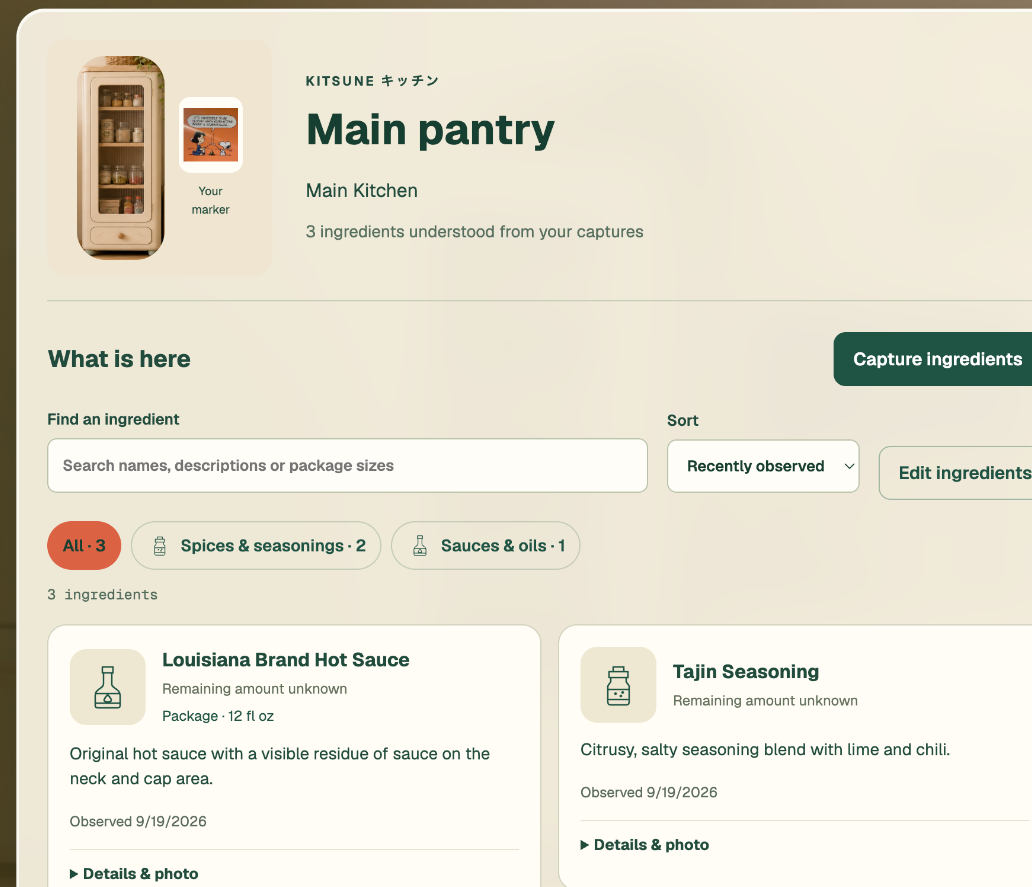
A useful result also needs to keep uncertainty visible. Reading a package size does not establish how much remains inside it. A photograph may show a product clearly while leaving its quantity unresolved.
One of our Kitchen development captures makes this tangible. The pantry contains three ingredient findings associated with “Main Kitchen,” with observation dates and controls for correction. Remaining amounts are marked unknown where the capture does not establish them.
That is a small piece of understanding, but it has a place, a time and a boundary.
Intention and actual effort.
The next connection is to the person’s actual effort:
Goal → Method → Task → Action + responsible human or AI agent
The goal identifies what someone wants to accomplish. The method supplies an approach. A task defines a piece of work, and the action records what was actually done and by whom.
An ingredient finding becomes relevant through those relationships.
Consider a person checking whether they have what they need for a meal. A successful check may reveal that something is missing. That finding can inform a change of method or a shopping decision. The check has contributed useful knowledge even though the meal has yet to be prepared.
The Kitchen DLA carries the methods and criteria for examining that work. It gives us a way to distinguish the result of a task, progress toward the person’s goal and what was learned through the effort.
This is also where existing knowledge meets lived observation. A producer may supply information about an ingredient. A method may describe how to use it. The person’s own activity establishes what happened in their circumstances.
The system needs to keep those sources connected and attributable.
Perspective across time.
A kitchen changes. Things are bought, moved, used and shared. Plans change too.
An observation from yesterday can still matter today, but its relevance depends on what happened afterwards. A later correction, another capture or a recorded action may give us a reason to revise the earlier understanding.
This is why time belongs inside the context.
We organize activity around before, during and after. Before carries intention and preparation. During carries the effort and adjustments. After gives us an opportunity to examine the outcome and what may be useful again.
Across those moments, we want the system to preserve a continuity of understanding: what happened, what is happening and what needs to happen next.
That is what we mean by developing Perspective.
A Perspective should connect the person’s intention with the available evidence, the effort made and the things still unresolved. A person should be able to see why an interpretation was made and correct it when it misses something.
The next interaction can then begin with relevant prior understanding. The agent has a basis for asking a better question, offering a more appropriate method or recognizing that a previous plan has changed.
What we carry forward.
The design gives raw captures a 72-hour window. That places a practical demand on processing: identify the permitted understanding worth carrying forward, while keeping its source, time and limits accountable as the original material expires.
An interpretation also needs to remain open to correction after it has been used.
We want people to retain authority over the context they contribute and how it can be used. Our Private, Personal, Professional and Public moments provide different settings for participation. Access to a finding must respect the permissions attached to it.
An agent’s usefulness depends on earning a place in those circumstances. That includes understanding when its information is incomplete and when it needs the person’s help.
Following the complete sequence.
The next complete example has to follow the same observation all the way through: from its physical reference, through processing, into a task, and then into a Perspective that can be revisited after something changes.
The slideshow follows the spatial context from MY SOT into the runtime and KNOW. The pantry finding shows a further piece: an observation represented as inspectable knowledge. Following one observation through processing, action and a later revision of Perspective is the next sequence we need to demonstrate.
The test is whether the system preserves enough context for the next interaction to be more useful—and whether the person can understand and correct what it carries forward.
The question that took shape in Yucca Valley continues to inform our work: how can a system find its bearings by learning from the world around it?
Today, we are building a place where people and agents can learn from everyday activity. The kitchen, its resources and the person’s own effort give that work something real to refer to.
Place gives an observation somewhere to belong. Intention gives it relevance. Experience gives us a reason to revise what we know.
Life is how we know.
Complete working note. Development captures retain their original dates.